At a glance
- Short answer
- Yes, eight titles: Donkey Kong Bananza, Mario Kart World, Splatoon Raiders, Fire Emblem Fortune's Weave, Pokemon Pokopia, Hyrule Warriors, Mario Tennis Fever and Yoshi and the Mysterious Book. All are documented as running on an Apple-silicon Mac; one has also been run on an iPhone 17 Pro Max.
- How you build it
- Either nxnative's script (build_ipa_from_nsp.py --platform mac-app) or the NX2Apple launcher's Builds page, which accepts a game folder or a single .nup. No prod.keys are needed for these six.
- What it costs
- A recent Apple-silicon Mac (reports come from M4 Pro and M6 machines), Xcode 27.2, your own game dump - but no prod.keys - plus several minutes of pipeline building on the first start.
The short answer
Yes — eleven Switch 2 games have a profile in public code, and each is documented as running on an Apple-silicon Mac. The upstream nxnative repository carries them: Donkey Kong Bananza, Mario Kart World, Splatoon Raiders, Fire Emblem Fortune's Weave, Pokémon Pokopia, Hyrule Warriors: Age of Imprisonment, Mario Tennis Fever, Yoshi and the Mysterious Book, Star Fox, Kirby Air Riders and The Legend of Zelda: Ocarina of Time.
Four limits matter as much as the result. Eleven out of 151 profiles is still a rounding error. They run on a Mac, and what has been tested is the opening of each game, not a playthrough. And it is not an App Store download: the route the profiles document is nxnative's own script, while NX2Apple's launcher takes a Switch 2 folder or .nup — and since v1.3.0 the project reports Donkey Kong Bananza built and played through that launcher on a Mac, an iPhone and an iPad. One title, not eleven.
Why most articles still say this is impossible. Through late October the story was "a private fork ran Mario Kart World once, nobody can reproduce it". That exact game now has a public profile that reaches the first race at 60 fps. Coverage older than a week is describing a different category.
How this went from one demo to eight titles in under two weeks
The eleven titles, and exactly how far each one got
"Runs" is doing a lot of work in every headline, so here is the projects' own accounting rather than ours.
| Game | What is documented | Where it stops |
|---|---|---|
| Donkey Kong Bananza Nintendo EPD · SDK 20.5.19 | Three sessions of about five minutes plus scripted runs to 15,900 frames. Opening, mining tunnel and the areas after it, guide movies included, 60 fps — dropping to 30 fps for a few seconds in busy scenes. Also played once on an iPhone 17 Pro Max (iOS 27.0.1), built from the command line. | Nothing past those opening areas, on either device. |
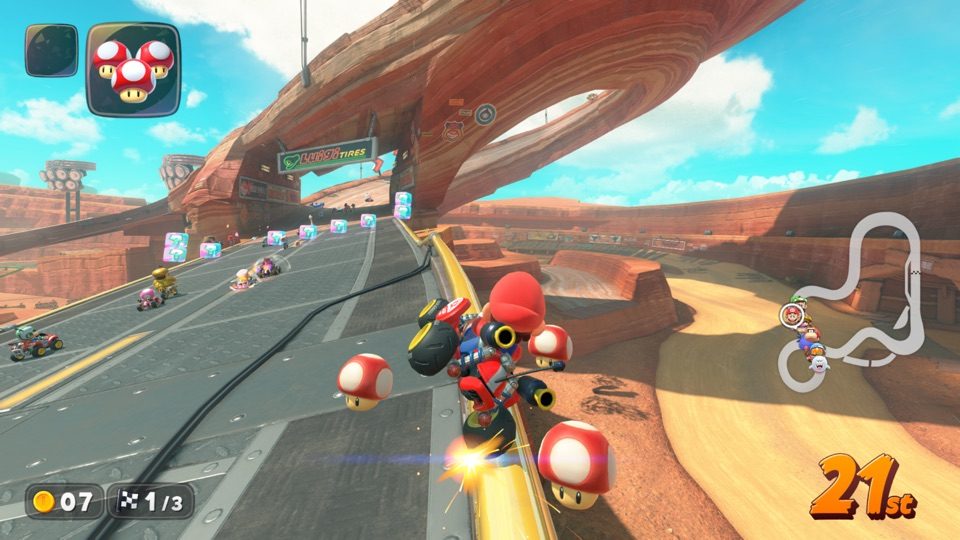
| Mario Kart World Nintendo EPD · SDK 19.3.3 | Reaches an actual race: title, menus, character / kart / cup / class selection, the Mushroom Cup opening and the first race of Mario Bros. Circuit at 50cc with items — 60 fps on an M6 Mac with 16 GB. | One circuit, one class. Update 1.8.0 is packed from a derived profile and was not on that machine. |
| Splatoon Raiders Nintendo EPD + Havok · SDK 21.4.4 | Opening, character creation, the first level's beach, inking, grates and the first Salmonids. About 4.5 minutes in the last session, no crash. | No iPhone build has been made at all. |
| Fire Emblem Fortune's Weave Intelligent Systems on NintendoWare · SDK 22.2.0 | The opening movie, the dialogue and the first battle map — whose first turn matches published footage — plus battle scenes in the author's playtest. | No iPhone build has been made at all. |
| Pokémon Pokopia Koei Tecmo KTGL · SDK 20.5.25 | The opening, the character choice and the first area's tutorial at about 60 fps, including 31 minutes of playtest with no GPU error and no crash. An earlier save loads and continues. | No iPhone build has been made at all. |
| Hyrule Warriors: Age of Imprisonment Koei Tecmo KTGL · SDK 20.5.15 | From a new save through first-run settings, the opening movies and cutscenes into the first field where Zelda walks; frame-time median 16.6 ms there. | Battles have not been reached. Long frames every few frames on a 16 GB Mac. |
| Mario Tennis Fever Camelot · SDK 20.5.17 | The title movie, practice, the main menu, Adventure's opening story, and Free Play singles on Stadium Court (Grass) with real rallies — 60 fps on an M4 Pro. | One court, one mode. No iPhone build has been made. |
| Yoshi and the Mysterious Book Unreal Engine 5.4.4 · SDK 20.5.15 | From a new save: the opening movie, Mr. E's dialogue, Chapter 1's page, the first habitat, walking, jumping and the flower friend, then ending the exploration and reloading that save — 60 fps on the Mac. | Chapter 1 only. No iPhone build has been made. |
| Star Fox Custom engine (its own eclipse) + Wwise · SDK 21.4.4 | The title, the prologue cinematic and the tutorial flight, with sound. The tutorial holds 56–60 fps while a 4K screenshot is written every 4 seconds, and 60 without them; the cinematic runs at 30 fps, which looks like the game's own cap. This is also the first profile here to use DLSS. | The tutorial flight is as far as it goes. No IPA has been built. |
Kirby Air Ridersphx / Aurora platform layer + PhysX 5.2 · SDK 20.5.26 | Title, attract mode, menus, a lesson and full Air Ride races from the start to the results screen on Floria Fields and other courses, scripted input and sound on. 57–60 fps in races after the first run, at about 10 GB resident. | No IPA, and no player has yet driven a race through a window on this build. |
| The Legend of Zelda: Ocarina of Time Nintendo EPD ( Owl) · SDK 22.2.8 | The title, the opening, a new file's first scene, Link's house and Kokiri Forest, with saves, at about 59 fps and a picture close to the console's own video. | Mac only so far, and nothing past the forest. |
Two of these are Koei Tecmo's KTGL engine, one is Intelligent Systems' NintendoWare, four are Nintendo EPD, one is Camelot's nxe, one is Unreal Engine 5.4.4 — and two are engines nobody outside the studio had heard of: Star Fox ships its own stack (prefixes vfs, vrender, vspirv, project eclipse) and Kirby Air Riders runs a phx engine on an Aurora platform layer. The SDKs run from 19.3.3 to 22.2.8. Eleven titles, seven engine families, nine SDK versions. That spread is what makes this look like a method rather than a lucky boot.
Why eleven games is a bigger deal than it sounds
Getting the first one there was not luck. Donkey Kong Bananza alone documents a long tail of work: 22,852 shaders written in Ampere-era 128-bit encoding rather than the Maxwell instructions Switch 1 titles use, so the translator had to decode a different instruction set before anything drew; the Switch 2's own tiling order for textures inside a graphics block, which is why one BC7 normal map came out wrong until that order was worked out offline; and several rendering faults before the first picture — a NaN in an environment cube's mip chain, an upscaler network that would not translate, an indirect-draw record stuck at zero because a store had been dropped.
Each later title added its own class of problem. Splatoon Raiders needed a bigger address space — 4.5 GB ran out at the first level. Fire Emblem brought a deferred renderer and PhysX. Hyrule Warriors is the one that shows the wall is not only shaders: it reaches gameplay and then runs into frame pacing, with long frames every few frames on a 16 GB machine. Mario Tennis Fever needed a 16 GB address region before its allocator would even start. And Yoshi is the interesting one: it runs on Unreal Engine 5.4.4 with a deferred renderer, so the layer is no longer only carrying Nintendo's in-house engines. That is what a young compatibility layer looks like from the inside.
What you need, before you spend an evening
| Item | Requirement | If you do not have it |
|---|---|---|
| Mac, or Windows | Apple silicon, and a recent one — the reported machines are an M4 Pro, an M6 with 16 GB, and one 16 GB Mac that showed long frames. Since v1.1.0 the Windows launcher also takes a Switch 2 folder or .nup | Linux and Android do not do this. The phone situation is barely better. |
| Xcode | Xcode 27.2 with the SDKs, on macOS 26.6 or later — take 27.2 from Apple's download page, not the App Store's newer Xcode | The build stops before it starts. |
| Your own dump | The game's files, dumped from a console you own — a folder of base/, updates/, dlc/, or a single .nup file | There is nothing to build. We do not host, link or explain how to obtain these. |
| prod.keys | Not needed for these eleven. The Switch 2 path builds straight from the game's own files | — |
| Disk | Around 10 GB free for the game data alone, plus room for the RomFS images and about 6 GB of build scratch | Bananza's update alone is 8.6 GB across 80,273 files, and its first build writes about 23,000 shaders. |
| A terminal | Or the NX2Apple launcher's Builds page, which accepts a folder or a .nup and marks Switch 2 titles in its library | If you want a finished product, wait: nobody has played one of these through the launcher yet. |
The build, as the profiles document it
- Lay the dump out by kind, or use the
.nup. A folder holdingbase/, the numbered update folder and any DLC folder — or the single package file, which is now the shorter route. - Build. From the command line:
build_ipa_from_nsp.py <folder> --platform mac-app. In the NX2Apple launcher: the Builds page takes the same folder or.nup. - Wait through the first start. Several minutes of pipeline building, once, before the first frame. Later starts read the archive and come up quickly.
Two details save you a pointless debugging session. The app may have no icon — a dump carries no control data, so that is expected. And these games need a Switch 2-sized memory pool; with a Switch 1 pool of 3.2 GB the heaps fail to allocate and the game never reaches its title screen.
Why a Mac first, and a phone only just now
A Switch 2 leaves a game about 9 GB of its 12 GB, and these profiles ask for pools in that range. Without the increased-memory-limit entitlement iOS gives a sideloaded app about 3,375 MB — a figure we measured on a 12 GB iPhone. The gap is not a setting.
It has been crossed exactly once. On 4 November NX2Apple's own game list recorded Donkey Kong Bananza as "played once on an iPhone 17 Pro Max with iOS 27.0.1, built from the command line, not built through the launcher yet". One session, one title, no product — but it is the first documented Switch 2 run on a phone that is not a private fork. That page keeps the running tally.
So the honest ordering stands: Mac first, phone barely. A Mac has no memory ceiling, no sideloading and no seven-day signature.
"Switch 2 emulator for Mac" — the other answer, and why it is empty
If you searched for an emulator rather than a compatibility layer, the honest state of that field is: nothing usable.
- oboromi calls itself "a work-in-progress Nintendo Switch 2 emulator foundation" and states that it cannot currently run commercial games or firmware. That is a scope statement, not a bug you can configure around.
- Pound moved its effort to a new ARM recompiler, with a timeframe measured in years.
The only Switch 2 software that has run on a PC is a modified build of an existing Switch 1 emulator reaching a character-select screen with severe slowdown. Meanwhile the compatibility route has eight titles with documented frame rates. That contrast is the whole story of this category: Switch 2 and Apple's chips are both ARM64, so the game's own code can run directly — what has to be rebuilt is everything around it, and that work is now being done in public, title by title.
Which Switch 2 games work
Eleven profiles out of 151 in the upstream registry; the rest target the original Switch's graphics API. The GUI fork's own game table documents seven of the eleven — Yoshi, Star Fox, Kirby Air Riders and Ocarina of Time are the four it has not picked up yet — and its library tags them Switch 2.
If your reason for reading is a specific game, the answer today is almost certainly that it does not run. The 62 Switch 1 titles we document are where the working software is for everything else.
What would change this page
- Footage past a first level in any of the eleven, which would move this from "opening areas" to "playable".
- A second Switch 2 title played through the launcher. Bananza is the only one; the other ten have only been run from the command line.
- The remaining 140 profiles staying Switch 1 while these eleven grow is the normal shape of a young platform. It changing quickly would be the surprise.
The legal side, stated plainly
This is the most exposed corner of an already exposed category. Nintendo has forced Switch emulators offline before, and it has begun issuing takedowns over Switch 2 material specifically. Nothing here is an endorsement or a how-to: dumping your own console's software is one legal question and distributing it is another, and we take no position on either. We do not host, link, or explain how to obtain game files or prebuilt packages — and a ported build contains the game, so it is not something to pass around.
Everything specific to the eleven titles — SDK versions, engines, session lengths, frame counts, the memory reservations, the iPhone and iPad runs through the launcher, the shader work and the "no IPA has been built" statements — is from their profile READMEs in the public nxnative repository and from NX2Apple's GAMES.md, both checked 2026-11-10. The 27-28 October private demonstrations come from contemporaneous coverage quoting the developer's posts. The 3,375 MB iOS figure is our own measurement. Emulator status for oboromi and Pound is taken from their own repository statements. The ordering of what counts as evidence, and the verdict, are our editorial judgement. We have not built or played any of these profiles ourselves.